One thing at a time, starting with what you can do.
Let us say this first: exterior work cannot stop a flood completely. Even so, we can reduce the water that pools on your land, block the paths it takes into the house, and cut down in advance the things the wind can carry off. This page sets out what can be done for that, starting with the things that cost nothing.
The construction talk comes later.
The Toki River crosses the prefectural border, takes the name Shonai River, and runs down into the Nobi Plain. We live upstream of that. Knowing what has happened on this ground before shows you where in your own house to prepare.
| Date | Cause | What the public record says | Source |
|---|---|---|---|
| August 1957 | Autumn rain front | Most of central Tajimi flooded (4,540 buildings in Gifu Prefecture) | MLIT — Shonai River flood history/MLIT — disaster history of the basin |
| September 1959 | Isewan Typhoon (Vera) | Levees broke in 13 places on the Shonai and Shin rivers (6,227 households in Gifu Prefecture) | MLIT — Shonai River flood history/MLIT — disaster history of the basin |
| July 1972 | Autumn rain front | Severe damage across the upper reaches, 6 deaths (1,515 buildings in Gifu Prefecture) | MLIT — Shonai River flood history/MLIT — disaster history of the basin |
| September 1989 | Typhoon No. 22 | Flood damage in the upper reaches (571 buildings in Gifu Prefecture) | MLIT — disaster history of the basin |
| June 1999 | Rainy-season front | 31 buildings flooded above floor level in the upper reaches | MLIT — Shonai River flood history/MLIT — disaster history of the basin |
| September 2011 | Typhoon No. 15 (Roke) | Severe flooding in Heiwa-cho, Ikeda-cho, Maehata-cho and Tashiro-cho in Tajimi (496 mm total rainfall in Tajimi) | Tajimi City — flood measures/JMA — disaster report |
| September 2026 | Linear rainband | The Shonai River overflowed; heavy-rain warnings for Tajimi and Kani | Gifu Prefecture Crisis Management Department |
Based on published material from the MLIT Shonai River Office, Tajimi City, the Japan Meteorological Agency and Gifu Prefecture. Building and household counts are the figures published as totals for Gifu Prefecture. The linked sources are in Japanese.
The first step needs no tools and no money.
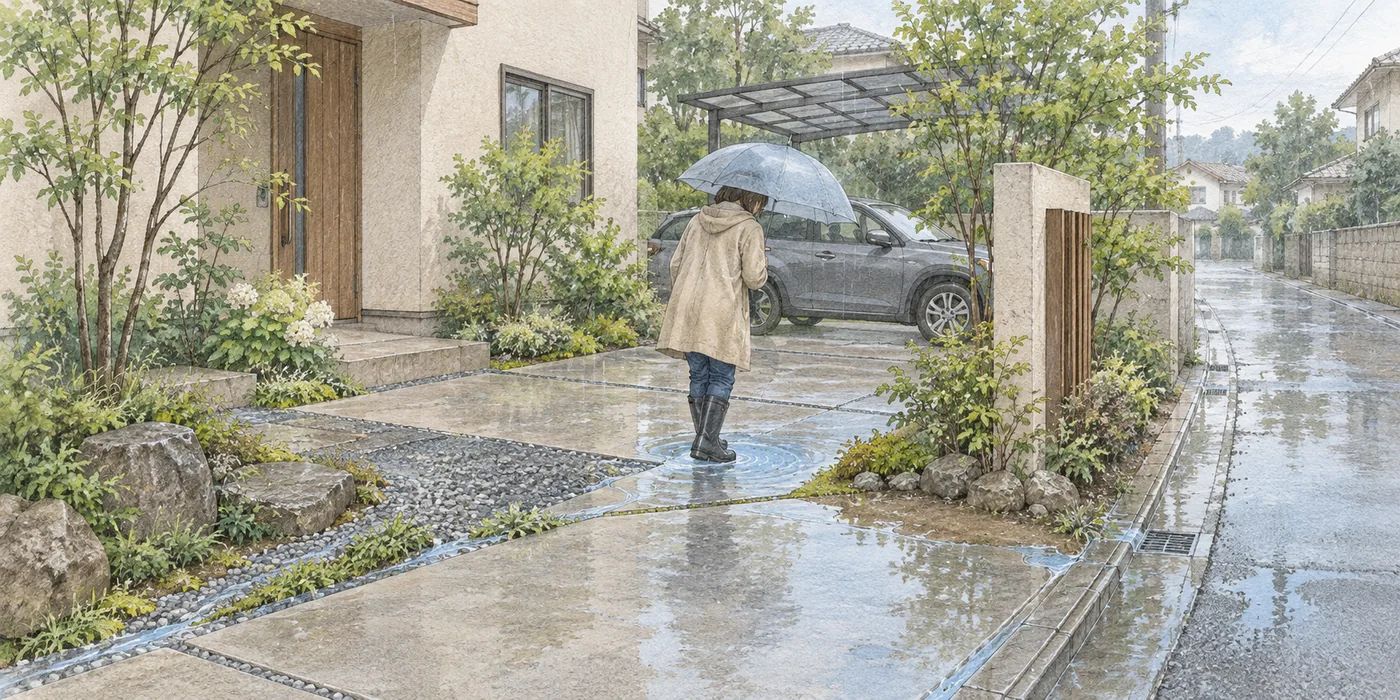
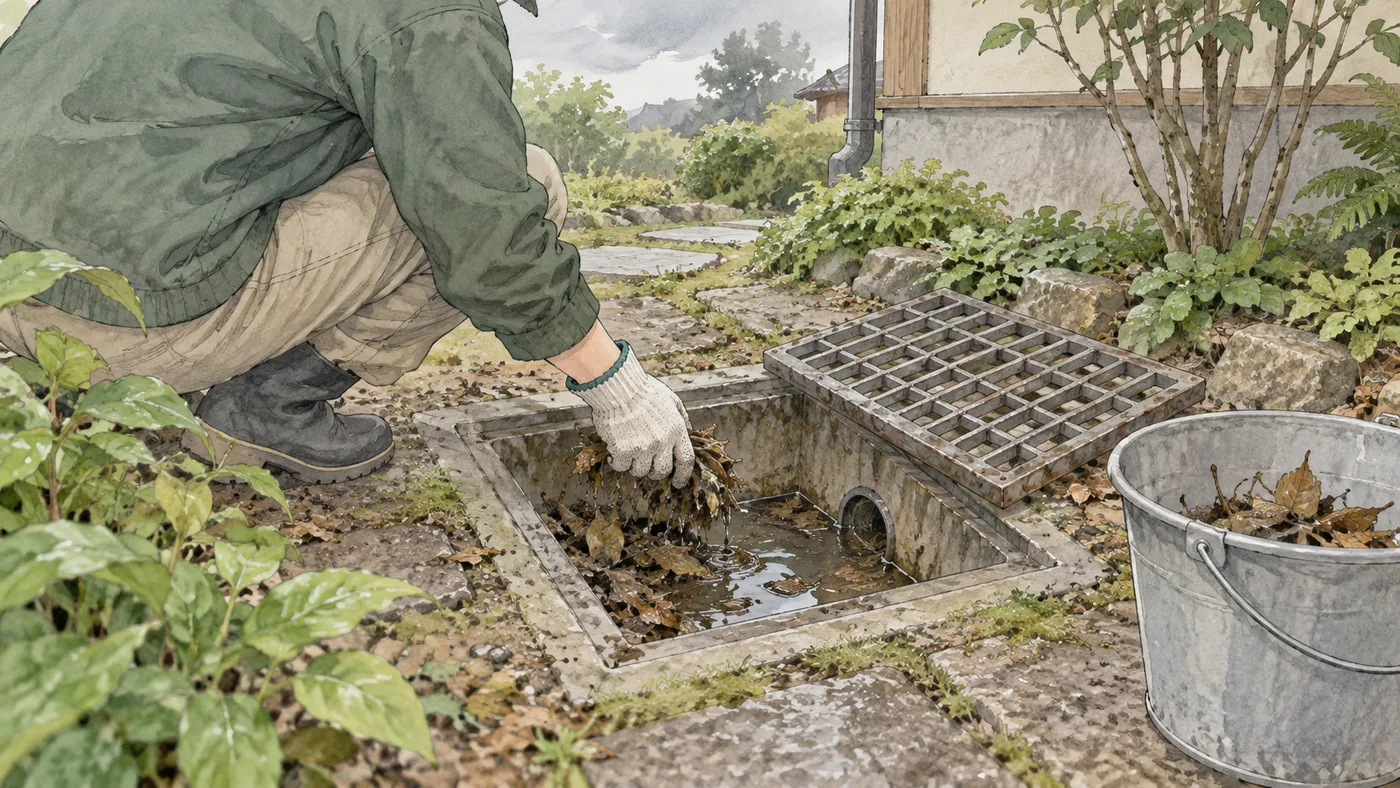
From here it is construction. The trouble, and what answers it.
Usually the cause is simply not enough slope. We re-cut the fall of the ground so water runs away from the building. Where it still gathers, we add a catch basin or a channel to give it a way out. A buried drain (ankyo, 暗渠 — a pipe run under the ground) is another answer.
A slab a car sits on will hold water if it is simply laid flat. We decide which way it should run and pour it with a fall too slight to see (concrete slabs). Choose permeable paving — a finish that lets water soak into the ground — and the surface itself drinks it. How fast it soaks away depends on the soil beneath.
A full-height garden window or a back door is an easy way in for water. One answer is a flood barrier (shisui-ban, 止水板 — a board that holds water back; some types slot in only when needed). And if a step for stacking sandbags is designed in at the entrance from the start, on the day you only have to set them down.
The road and the waterway itself belong to the city or the prefecture, so our hands reach only as far as your side of the boundary. A step of a few centimetres along that line, or a low retaining wall (dodome, 土留め) to hold back soil and water. That alone changes how much gets in. Where cars come and go, we work out the step together with you.
A soakaway basin (a basin that lets water sink into the ground) or a rainwater tank catches the rain where it falls. Less goes into the town's drains, and what you keep can water the garden. Some cities offer a subsidy for fitting them; we'll check before we come to you.
Exterior work cannot stop a river from overflowing.
Nor can it stop the flooding that happens when drains and channels cannot carry the water away.
Roads, channels and rivers are managed by the city and the prefecture. Our work reaches only as far as inside your boundary.
When that day comes, getting out comes first. People before things.
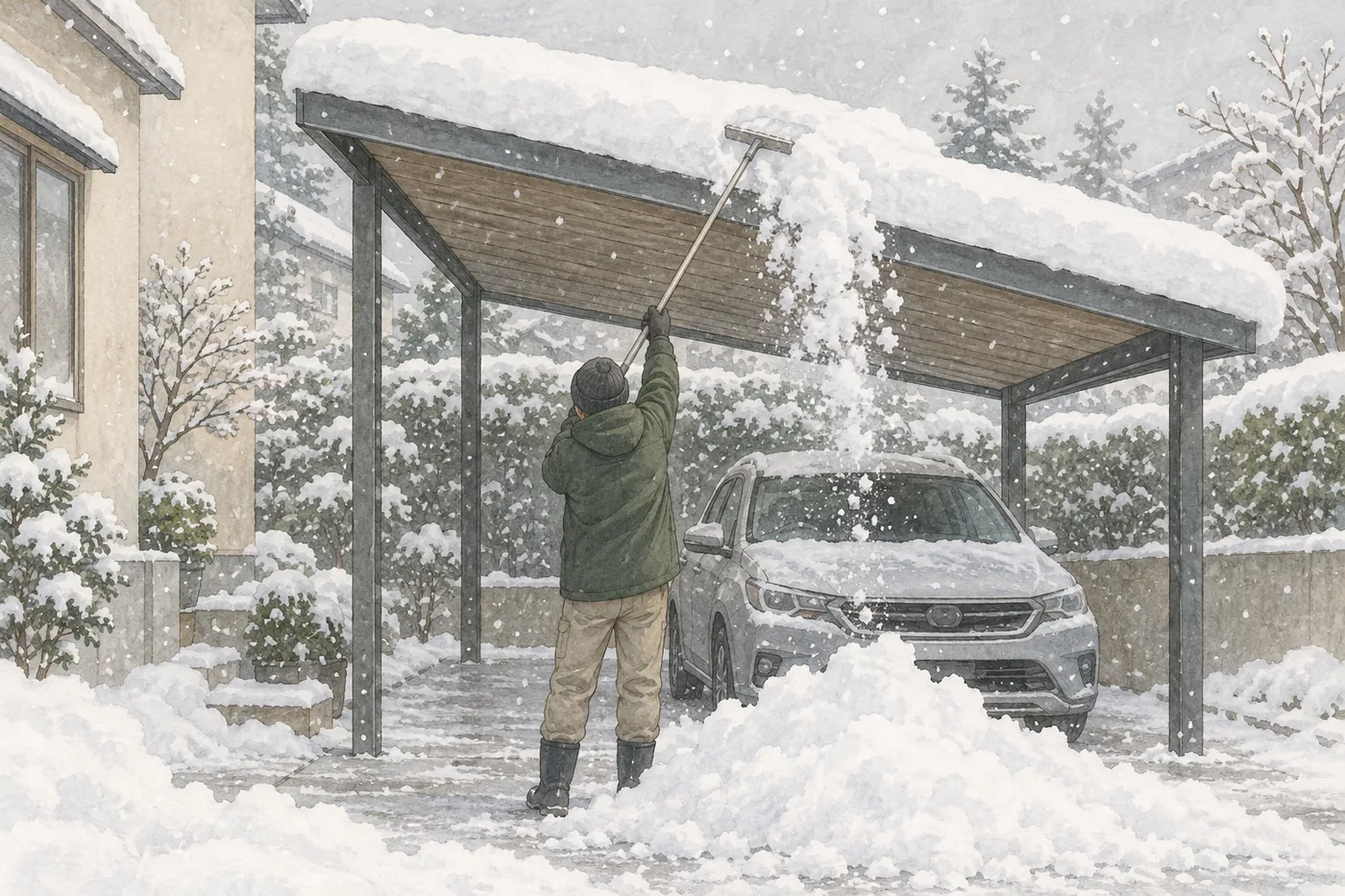
Even within Tono, around Ena and Nakatsugawa the snow falls heavily.
When a typhoon, heavy snow or water damages the grounds, your fire insurance (kasai hoken, 火災保険 — the cover that includes wind, flood and snow damage) may pay for the repair. Fences, carports, gates, walls — exterior work that is not the building itself is often included. Whether it applies depends on your policy and on what happened, so we cannot promise anything here. But from how to take the photographs to how to put it to the insurer, we'll help as far as we know how.
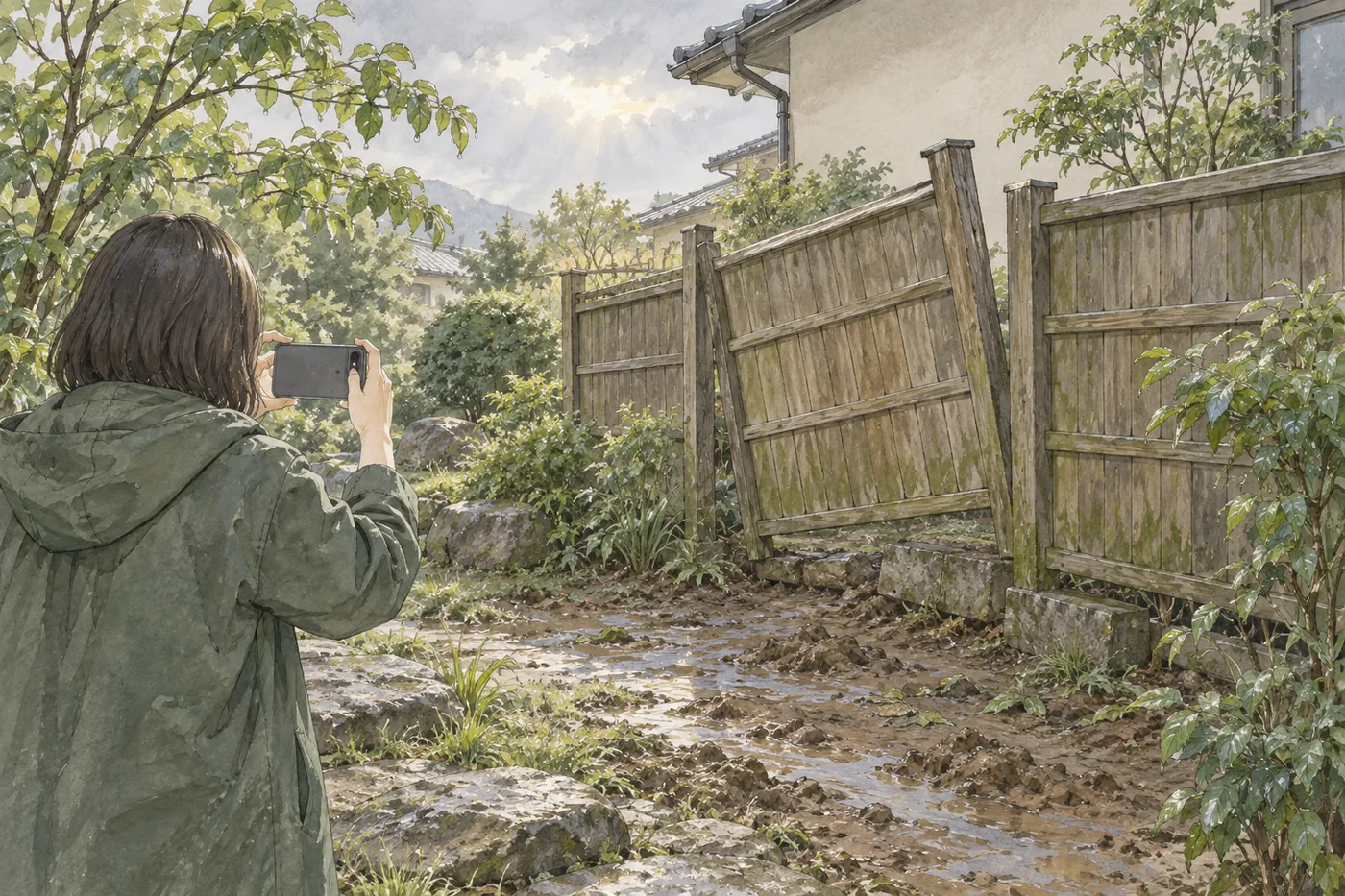
Once it is cleared away, nothing is left to show that the damage happened. Before you touch it, photograph it in this order.
Take more than feels necessary. That is about right.
When it comes to repair, exterior repair and restoration sets out what can be mended and how it goes. If it's urgent, call us and we'll hear it first.
Not completely. But it can reduce the water that pools on your land and block the paths it takes into the house. That means work on the fall of the ground and on drainage.
First, on a rainy day, watch where it runs and where it stops. Most often the slope is simply insufficient. Re-cutting the fall or adding a drain changes it.
If your policy includes wind, flood and snow cover, it may. Whether it applies depends on the policy and on the damage. First of all, keep photographs.
They are graded by how many centimetres of snow they bear. Clear the snow before it passes that, and most will hold. In a heavy year, clear it early.
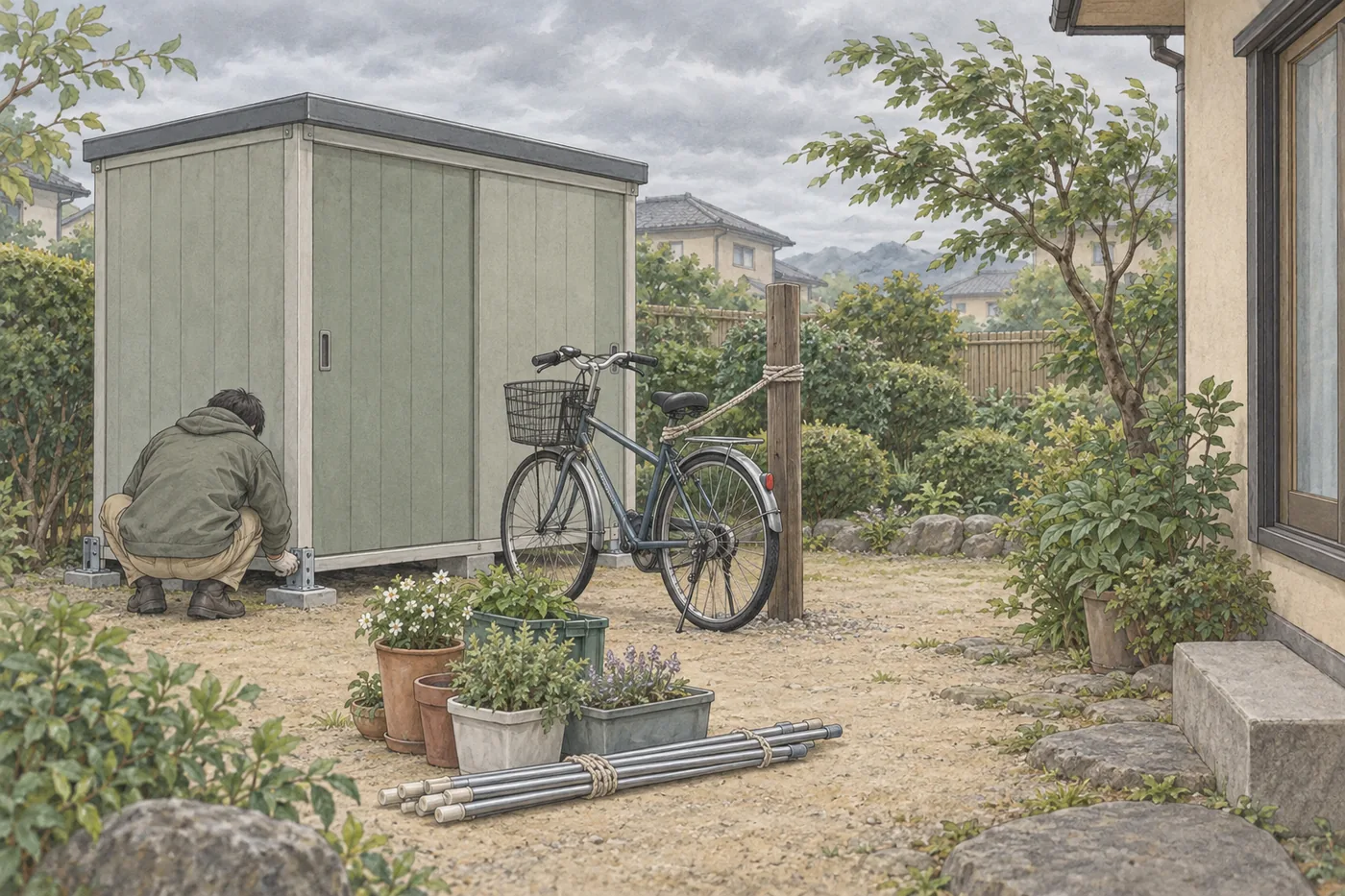
Anchor the shed and the bicycles, clear away anything that can fly, and take down the long branches. Check that the storm shutters actually move, the day before.
It depends on the work and the area. It ranges from adding a single basin to re-pouring a whole parking area. We come and look, then give you a figure. Consultation and estimate are free.
On a rainy day, take an umbrella and walk once around the house. You'll see where the water gathers and where it comes in. Everything starts from that.
Lift the lid and scoop out the leaves and mud — that is all. Work gloves and a trowel are enough. If the lid is heavy or the basin deep, don't force it; call us.
Home centres sell the bags and the sand. Your city hands them out at times as well — ask at the city office. A few by the front door are a comfort.
The road and the channel are managed by the city or the prefecture, so speak to the city office about those. On your side of the line, a step at the boundary or a retaining wall can hold it.
Coming to look and giving you an estimate are both free.
"After the rain, water sits right here." We start from a sentence like that, and think it through with you.
We live on this same ground, so we have a fair idea of how the rain falls here and how heavy the snow gets.
